
Run a Carlisle County Property Search
The Carlisle County PVA search is the natural first stop. Its application offers four modes: Owner Name, Location Address, and Parcel Number. Legal Information rounds out the choices. Start broad. Then copy identifiers exactly from the result. Those identifiers open the door to whichever office keeps the next property record you need.
- Enter the location address, leaving out punctuation or trying a shorter street form if an exact search misses.
- Open the parcel card and record its owner, parcel number, site address, mailing address, value fields, and legal description.
- Carry the owner name and deed reference to the County Clerk's eCCLIX land-record index.
- Compare the legal description and source-of-title reference, not merely a matching personal name.
- Ask the PVA or Clerk for help when an online result is blank, old, or unavailable.
Carlisle County Search Fields That Change the Result
The field you choose in qPublic matters as much as the text you type. An owner search can gather several parcels under one name. An address search aims at a single site. Legal Information earns its keep when a deed leans on a town lot, subdivision, road, creek, or adjoining owner. That field shines instead of a modern street number.
| qPublic mode | Useful input | Best use |
|---|---|---|
| Owner Name | Last name, person, estate, trust, or entity name | Find parcels held under one indexed owner |
| Location Address | House number and street; exact-match control | Locate a known physical site |
| Parcel Number | The identifier copied from a PVA card | Return to an exact tax parcel |
| Legal Information | Lot, block, plat, tract, farm, road, or creek words | Recover land with weak address data |
The application does show a range-style address example. But it publishes no exact Carlisle parcel-number pattern. Copy the full number as displayed. Guessing at separators will only slow you down.
Address, Owner, and Parcel Clues in Carlisle County
Each key answers a different question. An address suits land you already know. An owner name can reveal more than one holding, though trusts, estates, business names, and shared names all call for care. A parcel number is the strongest thread back to the same PVA tax record every time.
- Parcel number or APN
- The PVA's tax-record key for a mapped parcel.
- Situs address
- The physical location assigned to the property, which may differ from where notices are mailed.
- Owner of record
- The name carried on the relevant official roll, subject to timing and later recorded changes.
- Legal description
- The lot, block, plat, tract, or metes-and-bounds language used to identify land.
Never stop at a name match alone. Confirm the parcel number, legal description, acreage, and source-of-title reference before you move on to deed records.
Read a Carlisle County Property Search Result
A PVA parcel card pulls a lot into one place: ownership, addresses, assessment data, legal wording, sales, and improvements. The PVA describes its ownership, legal description, and valuation data as believed accurate. It also warns that sale price, sale date, and property characteristics may contain errors. Read empty cells as a prompt to check another source.
| Owner information | Name carried on the PVA record and a separate mailing block |
|---|---|
| Location | Situs address or physical-location description |
| Parcel number | The exact PVA tax key to preserve through the search |
| Value fields | Fair-cash and taxable values, subject to the displayed tax year |
| Legal information | Lot, tract, acreage, plat, or other identifying wording |
| Sales and improvements | Available transfer data, building details, sketches, or photos, with PVA disclaimers |
A parcel card may list a previous owner and sale date while leaving sale price and deed book/page blank. That does not mean no deed exists. It means the prior owner's name and that date belong in a search with the County Clerk.
Why Carlisle County's January 1 Roll Can Lag
Property in Carlisle County is assessed to whoever held title on January 1. That rule comes from the PVA. So a deed recorded later in the year can name a new grantee. The printed tax bill still shows the prior owner of record. That is a timing gap between two records, not proof that either office slipped up.
For a recent purchase, check the deed's recording date. Then compare it against the PVA owner block. If the update seems overdue, contact the PVA. The Sheriff advises a new owner who never receives a bill to reach out to that office or the PVA. A duplicate bill mailed elsewhere does not permanently change the address on the tax roll.
Carry a Carlisle County Result into eCCLIX
The Carlisle County Clerk land-record page routes visitors to eCCLIX, the Internet version of CCLIX. Carlisle residents may search free of charge for personal, noncommercial use. There is a limit of five searches per day. Commercial access requires a paid subscription.
Search the current PVA owner as a grantee first. Then match the legal description and any book/page or source-of-title clue. The Clerk publishes no firm start year for the online index. So never assume a missing early deed is absent from the official record. The Clerk counter and a record request remain the right fallbacks.
Entity and estate names deserve a second pass. Search the wording exactly as the PVA displays it. If the index allows, try a shortened form or initials. An estate in the owner field can lead to a will, affidavit of descent, or executor deed. It can also lead to a later conveyance. A business name can be checked for spelling in Kentucky's Secretary of State business search. That entity record does not prove ownership of the parcel.
Know the document category you want. KRS 65.032 names deeds, mortgages, fixture filings, plats, restrictions, easements, leases, powers of attorney, land contracts, wills, and title affidavits. These are among portal categories. A request with a category, party, date range, and legal description beats a request for every record tied to a name.
River Land and Rural Carlisle County Searches
Mississippi floodplain, river islands, rural roads, farms, creeks, and adjoining tracts can yield descriptions that outlive any mailing address. If a Carlisle County property search by street fails, switch tools. Use the legal-information mode. Try a predecessor owner's name, the acreage, or a named road or water feature.
Resist forcing ZIP geography into a city boundary. Bardwell's 42023 and Arlington's 42021 are fine search clues. A postal label proves nothing about incorporation. Address corrections belong with the PVA and the relevant local office. The recorded legal description belongs with the County Clerk.
When Carlisle County Property Search Screens Fail
Online screens are not the only route. The PVA office sits at 985 US Highway 62, Suite 111 in Bardwell. It can straighten out an address, parcel, owner, or value record in person. The County Clerk, at the same courthouse address, holds recorded land instruments. Under the Kentucky Open Records Act, the Clerk also offers an open-records inspection-request path. That path covers anything not displayed online.
Older material lives elsewhere. The Kentucky Department for Libraries and Archives lists Carlisle deed microfilm. The deed microfilm covers 1886 through 2007, and plats run from 1951 through 2008. Wills span 1886 through 2006. Tax books come in two separate runs. KDLA accepts records requests. The Ballard-Carlisle Historical and Genealogical Society and KYGenWeb can help locate names and book references. Those finding aids point the way. Official deed proof still comes only from the Clerk.
The local PVA search landing page appears in the manifest image below. Check the source page before relying on its current controls.
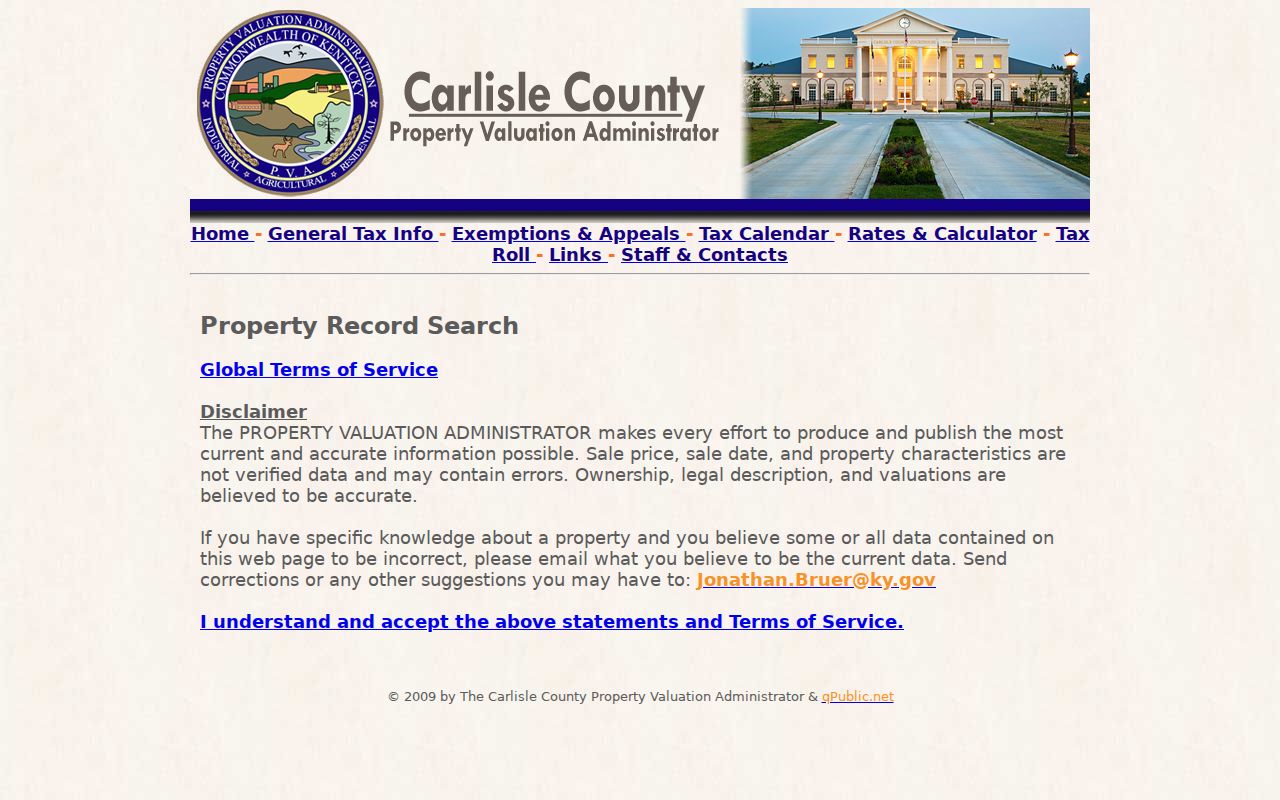
The landing page is only a gateway. It is not itself a parcel result or proof of ownership.
Older searches can cross a county line in time. Carlisle County was carved from Ballard County in 1886. Land held before that year may sit in Ballard predecessor books. That can happen even when the modern parcel lies in Carlisle. The county name changed while the tract stayed put. Anchor the search to the same land. Use adjoining owners, farm names, roads, creeks, and acreage.
KDLA shows a gap between tax-book runs covering 1886 through 1892 and 1970 through 2007. That gap in the finding aid does not mean no intermediate book survives. Ask the PVA, the Clerk, KDLA, and the local society for help. Ask which series name or repository covers the year you need.
Compare Carlisle County Property Search Keys
A good search changes keys when one route stalls. Start with the clue least likely to be ambiguous, preserve the exact spelling the source displays, and compare at least two record systems before drawing any conclusion.
| Search Key | Best For | Where It Works | Watch Out |
|---|---|---|---|
| Address | A known physical site | PVA qPublic | Mailing, old, and situs addresses can differ |
| Owner name | One owner's set of parcels | qPublic and eCCLIX | Estates, trusts, entities, and name variants |
| Parcel number | An exact tax-record return | PVA record and map route | No local format guide was published |
| Legal wording | Old or rural land without a good address | qPublic, deeds, and plats | Needs comparison with the full description |
Not a title search. A Carlisle County property search can locate public records, but it does not guarantee clear title or settle a boundary. Verify recorded instruments with the Clerk and obtain qualified title or survey help when the stakes require it.