
Build a Carlisle County Former-Owner Timeline
Start with the current grantee. Build one row for every earlier transfer. The Carlisle County Clerk land-record route serves as the online entry point, while older depth comes from courthouse volumes and archival microfilm.
| Transfer date | Grantor to grantee | Deed type | Book/page |
|---|---|---|---|
| Newest date | Seller to current grantee | Warranty, quitclaim, fiduciary, or other deed | Copy the exact reference |
| Prior date | Earlier owner to that seller | Deed or statutory affidavit | Follow source of title |
| Earlier link | Repeat with predecessor parties | Deed, estate transfer, or court order | Match land wording |
A bare list of names is not a chain. The timeline table forces proof at each step. A road, creek, farm, lot, town square, or adjoining owner can confirm continuity better than a modern address, and every deed description must track the same land.
Walk Carlisle County's Deed Chain Backward
Pull the current owner from the PVA. Then find the deed where that party was grantee. The grantor on that instrument becomes your previous-owner lead, so search that name as an earlier grantee, compare the land, and repeat the climb.
- Save the qPublic owner, APN, situs, and legal description.
- Find the newest deed to that grantee and note its date and source-of-title reference.
- Search its grantor as an earlier grantee and match the same land.
- Repeat until online coverage stops, then move to books or microfilm.
- Grantor / grantee
- The party conveying / receiving the interest shown.
- Chain of title
- The ordered, parcel-matched sequence of transfers.
- Legal description
- The durable land identity when a street address changes.
KRS 382.110 requires a source-of-title reference inside every deed or mortgage, and that citation makes a handy shortcut. Estates can break the name loop. Wills, descent affidavits, fiduciary deeds, and court orders may carry the parcel instead of an ordinary deed, so search those record types rather than assuming one is missing. Private, noncommercial users get five free daily eCCLIX searches. Commercial access runs on a subscription. If online access fails, call the Clerk at 270-628-3233 or inspect records at 985 US-62 in Bardwell.
Start Carlisle County History in Deed Book 1
The Deed Book 1 guide spans 1886 and 1887. It covers the Bardwell Town Square, town lots, street wording, parties, dates, and book/page references. Seven of its index pages are flagged missing. A gap in the index does not mean the deed vanished, so ask the Clerk or KDLA for the reel or original volume before calling a former-owner chain broken.
Continue Pre-1886 Owners in Ballard County
Carlisle County formed from Ballard County on May 3, 1886, so a tract held earlier may sit in Ballard deed books even though the parcel is in Carlisle today. The jurisdiction changed. The land did not move. Carry the owner, adjoining-owner calls, farm, road, creek, acreage, and legal description into the predecessor search.
Bridge Carlisle County Estate Transfers
A chain often looks broken after an owner dies. Death is rarely the end of the records. The next link may be a will, descent affidavit, conversion affidavit, executor's deed, court order, or later conveyance, and the local fee schedule lists several as distinct categories. Search the deceased owner, estate wording, fiduciary, and heirs. Then return to the recorded land instrument that ties the successor to the parcel.
Match Carlisle County's Old Land Descriptions
Old deeds speak in street names. Front, Elm, and Arlington Street wording fills early records. Present files may use a highway or newer situs. Rural deeds can name a creek, levee, island, farm, or adjoining owner. Neville and Holtsville serve as Arlington-era variants. Search those historic phrases as legal information. Then compare lot, acreage, neighbors, and source of title before trusting a match.
Investigate Carlisle County's Tax-Book Gap
KDLA lists assessment books for 1886 to 1892 and 1970 to 2007. The gap proves nothing. It defines a precise question for the PVA, Clerk, KDLA, and the local society. A dated tax owner can support an interval. The deed still wins. Ask whether a missing year sits in another office or under another series name before leaning on the tax roll alone.
Take Carlisle County Prior Owners Back to 1886
The local eCCLIX page does not publish its earliest online year. The KDLA inventory is firmer. Its KDLA land inventory shows deed microfilm spanning 1886 through 2007, plats from 1951 through 2008, and wills from 1886 through 2006. The Deed Book 1 finding aid goes further. It spans 1886 to 1887, with Bardwell Town Square entries, town lots, streets, parties, dates, and book/page clues. That index is required reading.
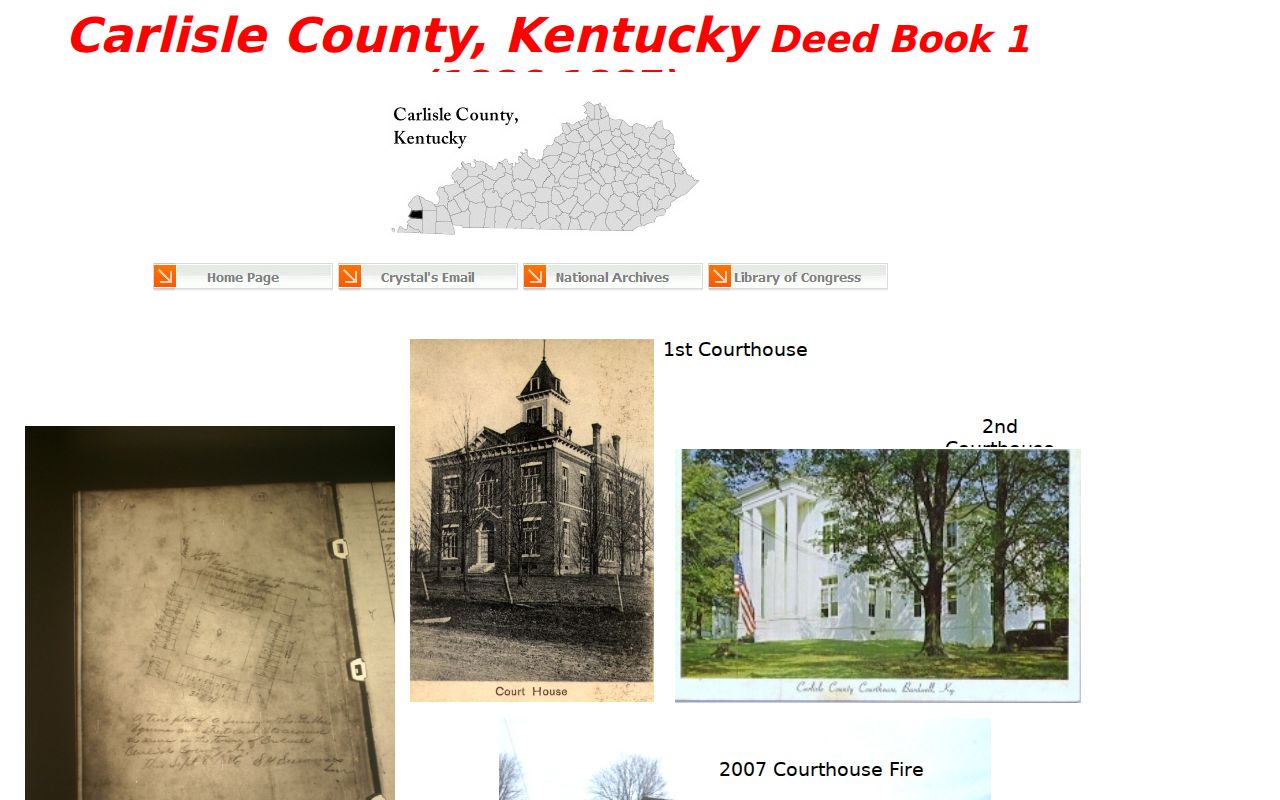
Use names, dates, land wording, and book/page citations together. No single detail carries the chain alone. The guide flags pages 118, 123, 146, 196, 201, 307, and 341 as missing from its index. The deed itself may survive. Carlisle County formed from Ballard County on May 3, 1886. The county name changed. The tract stayed put. Continue the former-owner search in Ballard predecessor books using names, roads, creeks, farms, and adjoining owners. KDLA accepts archive search-and-copy requests and estimates four to six weeks. The Ballard-Carlisle Historical and Genealogical Society can bridge a deceased owner through newspapers, court sources, surname files, and oral histories, though the final transfer still needs an official deed or court order.
Coverage limit. Carlisle County's online cutoff is unpublished. Older former owners require microfilm, deed books, probate sources, and sometimes Ballard County records.
Tracing prior owners in Carlisle County serves real purposes. House history, inheritance questions, and purchase diligence all draw on the deed chain. It never licenses tracking or harassing a living person. Carry a historic tract or town-lot phrase forward across address changes, because that older wording often links former owners better than today's situs does.
Plats add a second time layer to the work. Carlisle County's recorded plat series can preserve a subdivision name, lot and block, roads, dedications, easements, scale, and orientation. A plat alone cannot name the later owner, though. Match its book and page to the deed description, then step back into the deed chain for each transfer. West End Heights of Arlington is one subdivision phrase worth carrying into the Clerk index without inventing its plat date or lot count.
Tax and will records can test a stubborn interval. KDLA lists Carlisle tax books for 1886 to 1892 and 1970 to 2007, and the gap between them is plain in the finding aid. Treat that gap as a prompt rather than a conclusion. Ask the PVA, Clerk, KDLA, and local society where intervening material survives, since the listing is not proof that no assessment books exist. Wills run 1886 to 2006 on listed microfilm and may name heirs. A will alone, however, is not always the recorded land transfer.
Assemble the final former-owner packet piece by piece. Include the deed image or copy, the exact book and page, parties as indexed, the legal description, and a dated parcel card. Add probate or court material only when it explains a break in ownership. This record-by-record method is slower than collecting search-result names. It preserves time depth and avoids merging separate Carlisle tracts.
When eCCLIX returns no former owner, vary your approach. Shift initials, surnames, estate labels, corporate suffixes, and party roles. The public wrapper does not expose its detailed search-field table without a session, so do not claim filters beyond what you can see. A precise Clerk request works better: name the record category, the parties, an approximate date, the legal wording, and any known source-of-title reference.
Historic addresses deserve the same care. Front, Elm, and Arlington Street references appear in early material, while modern county records may use US-62 or a different situs form. Search an old street as legal-description text first. Then match its lot, adjoining owner, and deed reference to the current parcel. For Arlington land, Neville and the proposed Holtsville name can also appear as historical catalog or newspaper terms. Record every spelling variant, party role, date span, and source you tested.