
What Carlisle County Deed Records Document
In Carlisle County, the County Clerk serves as recorder under Kentucky's Chapter 382 system. That means deeds get recorded in the county where the land lies. Or most of it, anyway. Each recorded instrument names the parties and spells out the land. Most also carry a source-of-title reference. That reference points back to an earlier book and page. That way, the ownership chain stays connected.
| Deed Type | What It Does | Common Use |
|---|---|---|
| Warranty deed | Conveys title with stated warranties | Ordinary arm's-length transfer |
| Quitclaim deed | Conveys only the interest the grantor has | Family or interest cleanup |
| Correction deed | Corrects an earlier recorded instrument | Name or description correction |
| Commissioner's deed | Conveys through court-authorized action | Judicial sale or partition |
| Executor or fiduciary deed | Conveys through estate authority | Probate-related transfer |
Not everything indexed beside a deed works like one. Mortgages, easements, liens, restrictions, releases, and lis pendens all appear in the Carlisle County records alongside deeds. A mortgage or lien burdens an interest rather than transferring it, so it never replaces a deed as proof of ownership.
Carlisle County Clerk and eCCLIX Access
The Clerk's land-record page lays out two ways into eCCLIX, the online form of CCLIX. Carlisle County residents handling personal, noncommercial questions can use the free private-citizen path. That route allows up to five searches a day. Commercial users must register for a paid subscription. That subscription can cover additional counties.
| Control or route | What the source confirms | Limit |
|---|---|---|
| Private Citizen Records Search | Free personal, noncommercial Carlisle search | Five searches per day |
| Commercial User Records Search | Subscription access with county selection | Paid account |
| Login | Username, password, Remember Me, recovery, and signup | Registered environment |
| Images | Registered users may view or print online documents | Exact image coverage and price unpublished |
The county's eCCLIX portal does not present its grantor, grantee, document-type, date, or book-and-page search controls to casual public view. Treat the deed records there as a partial resource, since the county does not promise that the full historical run of Deed Books has been imaged.
Fields in a Carlisle County Deed Entry
A practical field model emerges from the local eCCLIX page. It also draws on the public Deed Book 1 finding aid. Note the record date, the book and page, and the instrument type. Copy grantor and grantee spellings exactly as written, and capture the full land description. These details let clerk staff pull the deed quickly. They also keep two people with similar names from being confused in the property records.
| Party fields | Grantor or seller, grantee or buyer, plus estate or fiduciary wording |
|---|---|
| Reference fields | Book, page, date, and instrument type |
| Land fields | Town lot, street, tract, acreage, or subdivision description |
| Image status | An index lead or viewable image is not automatically a certified copy |
Keep the source-of-title language intact. Kentucky law requires that reference in covered instruments, and it is often the shortest path back from a present deed to the earlier one in the deed records.
Follow Carlisle County's Grantor-Grantee Trail
Reconstruct a chain of title by making each seller the subject of the next backward search. Names only start the process. At every step, compare the land description, the acreage, any plat reference, and the stated source of title. This keeps the chain tied to the same parcel. A deed records search done this way holds up. Each link in the grantor-grantee trail rests on the land itself rather than on a shared surname.
- Find the current acquisition deed by searching the present owner as grantee.
- Read the grantor, legal description, recording reference, and source of title.
- Search that grantor as an earlier grantee, allowing for initials, estates, trusts, and entity names.
- Repeat only when the description matches; move to books or microfilm when the online trail ends.
- Grantor
- The party transferring the interest.
- Grantee
- The party receiving the interest.
- Chain of title
- The linked sequence of instruments affecting ownership of the same land.
- Book and page
- The local citation used to locate an instrument within recorded volumes.
Carlisle's First Deed Book Has Missing Index Pages
The Carlisle Deed Book 1 index spans 1886 and 1887. It covers deeds, commissioner's deeds, and powers of attorney. Town lots and street references appear too. A Bardwell Town Square plat drawing rounds it out. Seven index pages are flagged as missing: 118, 123, 146, 196, 201, 307, and 341.
Remember what this aid is. A volunteer compiled it, not the official recorder's index. A gap in the index does not mean the deed itself vanished. Pull the party, date, description, book, and page clues. The Clerk or Kentucky archives can then supply the volume or microfilm.
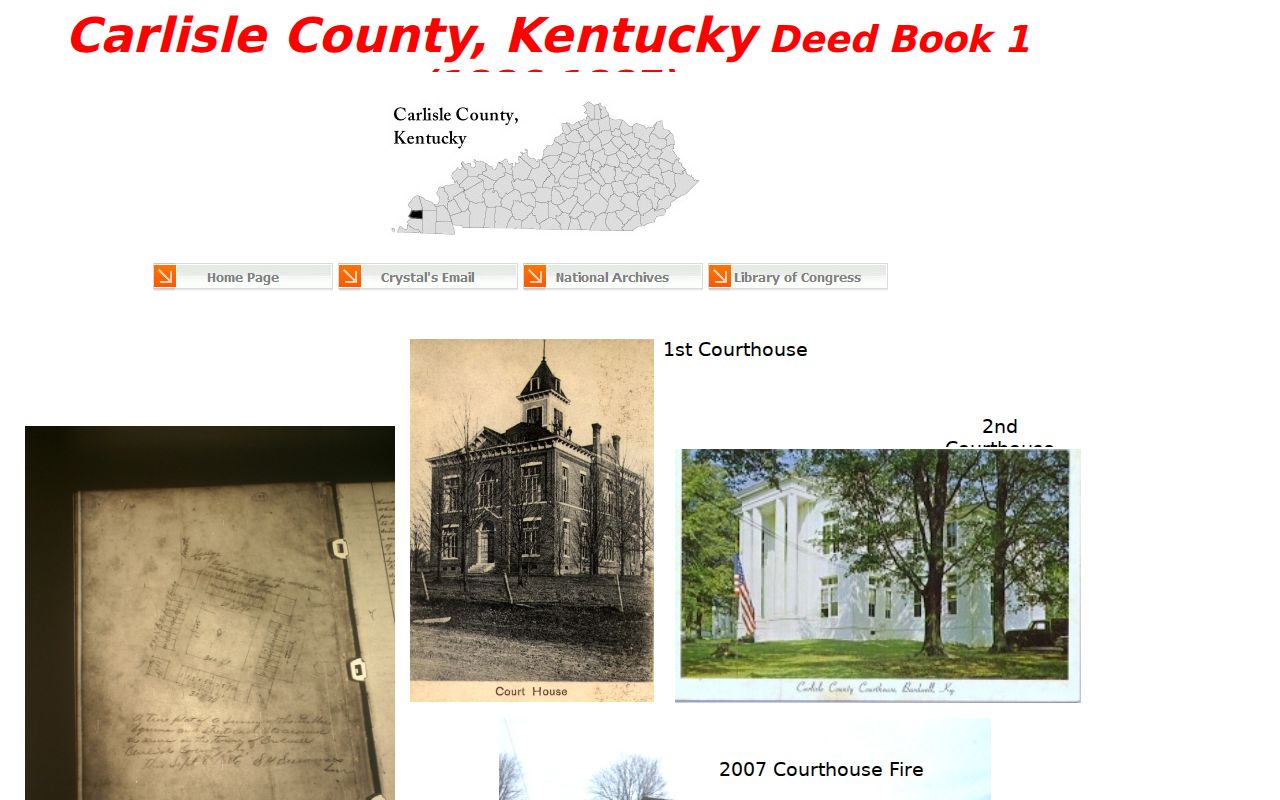
The guide works best as a bridge. It moves you from names and town-lot wording toward an official copy of the deed.
Carlisle Deeds Reach Back to County Formation
Carlisle County deed microfilm runs from 1886 through 2007 in KDLA's land-record inventory. The county itself formed from Ballard County on May 3, 1886. That matters for older chains. A conveyance before formation may sit in Ballard records even though the land now lies in Carlisle. Follow the parent county when the trail goes cold.
The same inventory lists companion collections. Plats run from 1951 through 2008, wills from 1886 through 2006, and entries from 1887 through 1905. These can explain estate conveyances, subdivision lots, and older land-entry clues. Still, the recorded deed or statutory affidavit remains the true ownership link.
Rural chains often resist neat lot-and-block descriptions. Preserve roads, creeks, farms, acreage, calls, and adjoining-owner names instead. Platted land works differently. Match the subdivision, lot, block, and plat reference there. KRS 382.115 ties applicable subdivision transfers to a recorded plat. KRS 382.135 covers consideration and mailing addresses.
Probate can branch the chain rather than settle it. Carlisle's local fee list confirms wills, affidavits of descent, affidavits of conversion, deeds, and renunciations or disclaimers as recorded categories. Read that trail first. Then locate the land instrument that moves the interest to the next owner of record.
Doc Alert Watches New Carlisle Filings
The County Clerk's 2026 homepage promotes free Doc Alert notices. A subscribed person or business name gets flagged. That happens when a deed or mortgage is filed under it. Treat the alert as a notification layer only. It does not authenticate a filing, certify ownership, or replace review of the instrument itself.
An unexpected notice deserves a closer look. Obtain the filed image or copy first. Compare the legal description and parcel against your own records. Then contact the Clerk through an independently verified number. Name-based alerts can also catch a different person or business with similar wording. Confirm before assuming anything.
Obtain a Carlisle County Deed Copy
Visit the Clerk counter at 985 US-62 in Bardwell. Hours are Monday through Friday from 8:30 a.m. to 4 p.m. You can also call 270-628-3233. Bring party names, the approximate date, the instrument type, and a book/page citation when known. The Clerk's open-records page offers another route for a precise inspection or copy request.
The local recording schedule posts a $50 fee to record a deed. A correction deed costs $46. A plat runs $50. Those figures are recording fees. They are not a published price for an ordinary or certified copy, so confirm copy and certification charges with the Clerk. KDLA also accepts archive requests, charging a nonrefundable search/copy fee and advising a four-to-six-week estimate.
An online image works well for reading names and legal descriptions. A certified copy carries the custodian's certification instead. Tell the Clerk which form the request needs. Without a citation, supply the parties, approximate date, instrument type, and land description. A narrow request also keeps an inspection apart from title research.
Keep the index citation with the copy. A later researcher can use it to check corrections, releases, easements, restrictions, or the source of title. When the question is the full chain of ownership, one deed should never be read alone.
Recorded, not guaranteed. Carlisle County deed records show what reached the public record. They are not a title opinion, and unrecorded interests or indexing errors can exist.